Strength · Explainer · 4 min ·
How fast should you lift each rep? Set your tempo and see what changes
Does it matter how fast you lift? Studies on rep speed found similar muscle growth for reps lasting from about half a second to about eight seconds, as long as you stay in control.
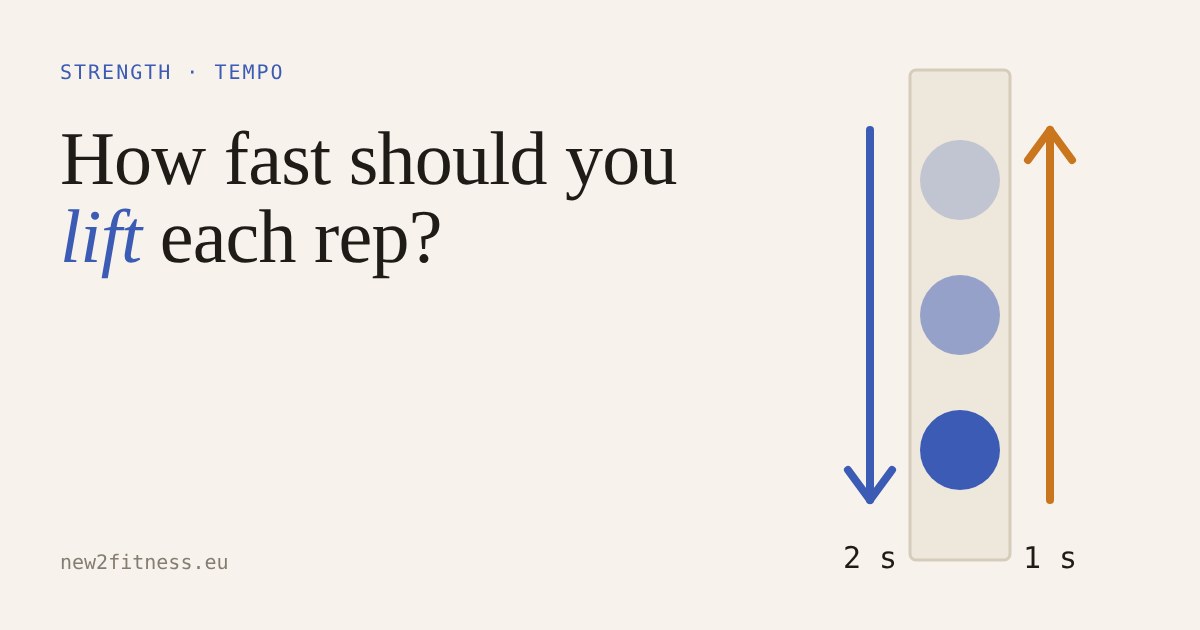
Move the sliders to see how tempo changes the length of a set and the weight you can use, and why a steady two seconds down, one second up is a sensible default for your first year.
Walk into any gym and you will see two kinds of lifter: the one who bounces the bar off their chest, and the one who takes five seconds to lower a dumbbell. Both are sure they have the secret. The research says something calmer: for building muscle, the speed of each rep matters much less than most people think, as long as you stay in control.
What "tempo" means
Tempo is just how long each part of a rep takes. A rep has a lowering part (the muscle lengthens under load, like going down in a squat), an optional pause, and a lifting part (the muscle shortens, like standing up). Coaches write it as three numbers: a "3-0-1" tempo means three seconds down, no pause, one second up.
The reason people care is time under tension: the total seconds a muscle is working during a set. Slower reps mean more seconds per rep, so it sounds like they must build more muscle. Try it below and notice the catch.
What the studies found
A 2015 review and meta-analysis by Brad Schoenfeld and colleagues pooled the studies that compared rep durations. Muscle growth was similar across reps lasting from roughly half a second up to about eight seconds. In other words, a quick, controlled rep and a deliberate slow one grew muscle about equally.
A later 14-week study in untrained men trained one leg with 2-second reps and the other with 6-second reps, every set taken to failure. Both legs grew and the difference between them was not significant. Strength on the lifted weight was also similar. The slower leg did gain a bit more strength in one isometric test with the knee bent only slightly, so slow reps are not useless, they just are not magic.
The catch with very slow reps is simple: the slower you go, the lighter the weight has to be, and the set gets long and tiring in a way that has little to do with the muscle. There is little evidence that extremely slow reps (ten seconds or more) help, so there is little reason to try them.
Why the middle works best
- Control, not speed, is the point. If you can stop the bar anywhere, you are controlling it. If momentum is doing the lifting, you are not training the muscle you think you are.
- Lowering is where beginners rush. Taking a couple of seconds to lower the weight is an easy way to keep form tidy and avoid dropping into the bottom of a lift.
- You can still lift with intent. Pushing the lifting part with purpose, without jerking, is fine.
- Heavy is heavy. Whatever tempo you pick, the last reps of a set should feel hard while your form holds.
A simple rule for your first year
Lower for about two seconds, lift in about one, and do not bounce at the bottom. That is a 2-0-1 tempo and it needs no stopwatch: counting "one-thousand-one, one-thousand-two" on the way down is enough. If a lift feels shaky, slow the lowering to three seconds or add a one-second pause at the bottom so you cannot use a bounce.
Change the tempo only when something specific calls for it, such as a pause to fix a wobbly squat. Add reps or weight over the weeks, not tempo gymnastics.
This is general information, not medical advice. If a movement causes pain, or you have an injury or a health condition, check with a doctor or physio before changing your training.
Take-away
Pick a controlled tempo, roughly two seconds down and one up, keep it the same from rep to rep, and spend your effort on adding reps and weight over time. That is the part that actually moves the needle.