Strength · Tool · 4 min ·
How much can you lift once? Type your set and estimate your one-rep max
Do a clean set of 3 to 8 reps, count them, and a formula gives you a ballpark of the heaviest weight you could lift once.
Type in your own weight and reps, compare three well-known formulas side by side, and see why long sets give shakier answers. A table turns the estimate into working weights.
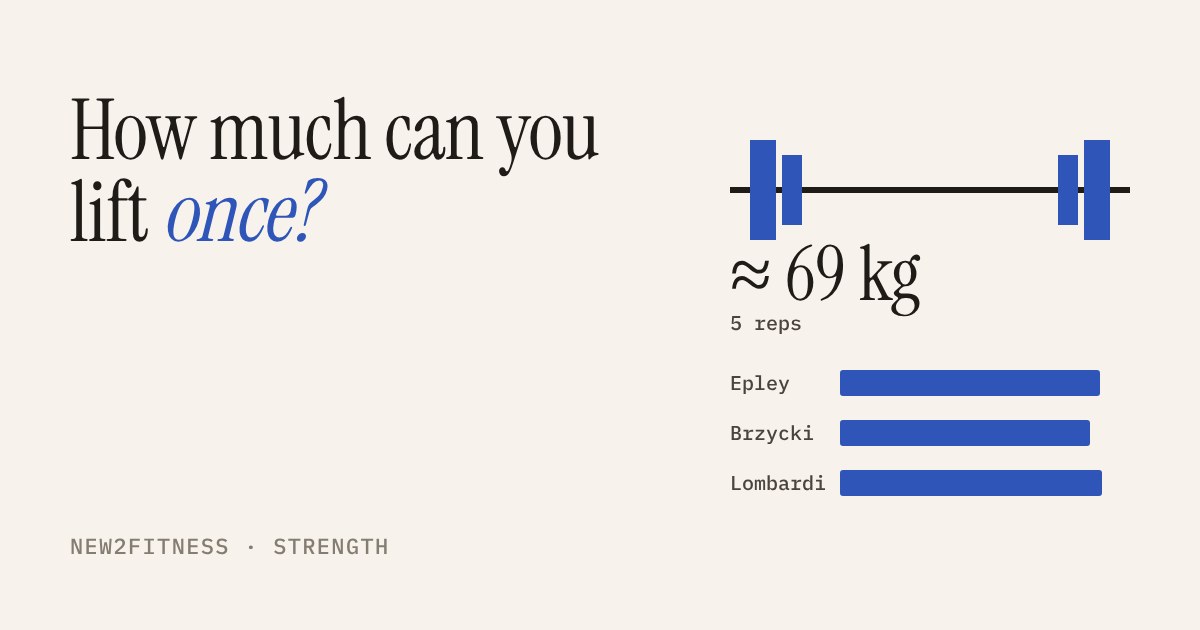
You do not need to lift the heaviest weight you possibly can to know roughly how strong you are. Do a set you can finish with good form, count the reps, and a formula gives you an estimate of your one-rep max (1RM): the heaviest weight you could lift once. Programmes often write loads as a percentage of it, so a decent estimate is useful.
The catch is that the estimate is only as good as the set behind it. Try it below.
How the formulas work
Every formula starts from the same observation: the more reps you can do with a weight, the lighter that weight is compared with your max. They turn your reps into a multiplier. The three used above are Epley: weight × (1 + reps ÷ 30), Brzycki: weight × 36 ÷ (37 − reps) and Lombardi: weight × reps^0.10.
They agree closely at moderate reps and disagree more as reps climb. Epley and Brzycki give the same answer at 10 reps; below that Epley reads a little higher. Estimates from submaximal sets can still be off by 10% or more for some people, so use the middle of the range, not the top.
Which set to use
Pick a set of 3 to 8 reps where you stopped because the bar was slowing down, not because you were bored or out of breath. Stop with one or two reps left in the tank if you are new; a set of 5 that you could have extended to 7 will underestimate your max, and that is a safe error to make.
Use the same exercise, the same depth or range of motion, and the same technique each time. A squat to a box and a squat to full depth have different maxes. Do your estimate after a warm-up, not cold.
Why not just test a true max?
A true one-rep attempt is the most accurate way to find your max, and it is considered safe when done properly. But it takes long rests between attempts, it can feel intimidating, and there is a risk of injury if your form is still settling in. When you are new, a set of five tells you almost as much with far less drama. If you do want to try a heavy single someday, use a spotter or safety arms.
What to do with the number
Use it to choose starting weights, not to judge yourself. Many programmes say things like "3 sets of 8 at about 70% of your max". The table in the tool above turns your estimate into those weights. It will drift as you get stronger, so re-estimate every few weeks from a fresh set.
If an exercise causes pain, or you have a heart condition, are pregnant or are returning from an injury, check with a doctor or physio before lifting heavy. This tool is for healthy adults training for general fitness.
A worked example
Say you squat 60 kg for 5 clean reps. Epley gives 60 × (1 + 5 ÷ 30) = 70 kg. Brzycki gives 60 × 36 ÷ 32 = 67.5 kg. Lombardi gives 60 × 5^0.10 ≈ 70.5 kg. The middle is about 69.5 kg, so call your max "somewhere around 67 to 71 kg". A working set of 8 reps would then sit near 70% of that, about 48 kg.
Now say you did 60 kg for 20 reps. The formulas stretch far past where they were built to work, and the answers scatter. That set tells you about your endurance. It tells you very little about your max.
Common mistakes
The first is counting reps that were not clean: bounced, half-depth or with a rounded back. Only count reps you would be happy to repeat. The second is comparing across exercises. Your bench max says nothing about your row max. The third is chasing the number. A beginner who adds a rep or two every week is making real progress even if the estimate moves only a little, and the estimate matters far less than showing up.