Strength · Explainer · 4 min ·
When should you add weight to the bar? Log your sets and see when to go up
When should you add weight to the bar? A simple rule called double progression answers it: pick a rep range, add reps each session, and only go heavier once every set reaches the top of the range.
Log three sets in the interactive and see what to do next session, including what a jump of 1, 2.5 or 5 kg does to your reps. It fits almost any beginner lift, and it tells you when to wait, as well as when to go up.
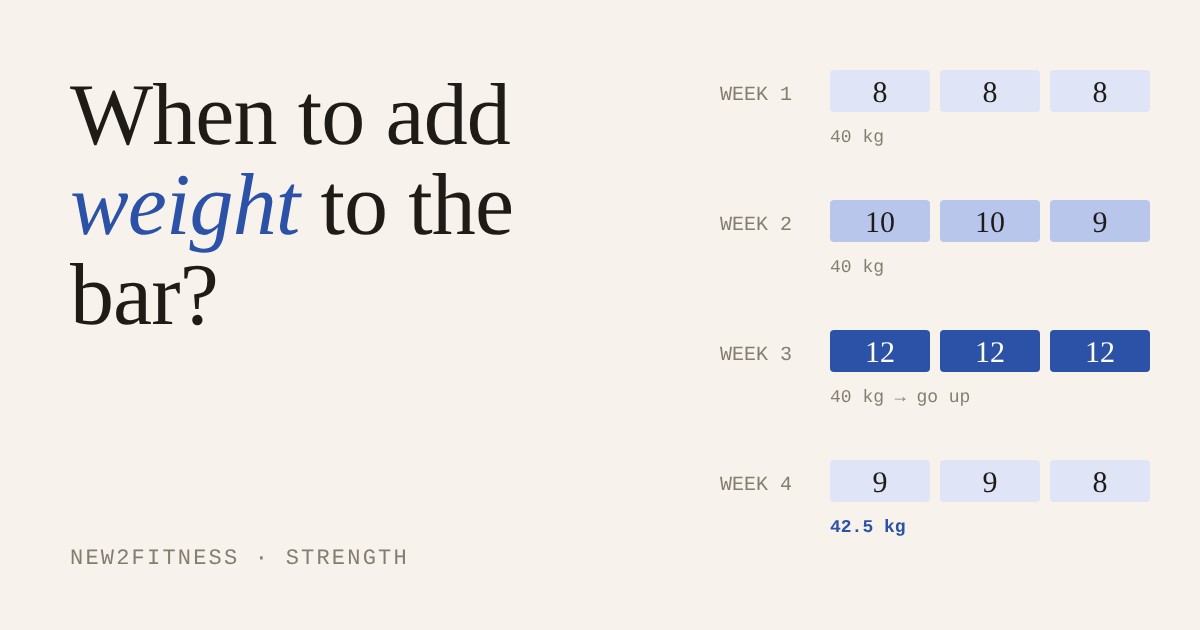
You lifted 40 kg for three sets last week. This week it felt fine. So should you add weight today, or wait? Most beginners guess, and guessing leads to two common problems: jumping up too early and grinding out ugly reps, or staying on the same weight for months because it never feels like the right moment.
There is a simple rule that removes the guesswork. It is called double progression, and it works for almost every exercise you will do in your first year.
The rule: reps first, then weight
Pick a rep range, for example 8 to 12. Start with a weight where you can do the bottom of the range (8 reps) with good form, leaving a couple of reps in the tank. Each session, try to add a rep. When every set reaches the top of the range (12), add a little weight next time and start again near the bottom of the range.
That is the whole method. Progress shows up in two places: more reps at the same weight, then a heavier weight. Both count as getting stronger, and the rep targets give you a clear reason to wait or go up.
Try it with your own numbers
Set your exercise below, then tap the rep counters to log what you did across three sets. The coach tells you what to do next session.
Why it works
Your muscles and tendons adapt to being asked to do slightly more than before. That extra can be one more rep or a little more weight; your body does not care which, as long as the effort is real. Using a rep range gives you a middle step. Instead of an all-or-nothing jump in weight, you get several small wins first, and the weight increase only comes once you have clearly earned it.
For a beginner, progress in the first months is often fast, so it is normal to be able to add reps or weight most weeks on the main lifts. It slows down with time. That is why the smallest jump matters: tiny jumps keep the method going much longer.
How big should the jump be?
As a rule of thumb, the smaller the muscle group, the smaller the step. On a barbell, 2.5 kg in total (a 1.25 kg plate on each side) is a common step for upper-body lifts, and 5 kg is common for squats and deadlifts. With dumbbells, you usually go to the next pair up. If your gym only has big jumps, add reps first, or use a fractional plate or a lighter band if you can.
A jump that is a large share of your current weight will drop your reps a lot. The figure above shows this: 2.5 kg on a 20 kg lift is a big step, while on 80 kg it is tiny. That is why isolation exercises and dumbbell lifts need patience.
When not to add weight
The rule says when you may go up, not when you have to. Stay put if form is slipping, if you slept badly and everything feels heavy, or if you cut your rest short and the reps suffered. A repeat week is not a failure; it is part of the plan.
Keep the effort honest. Most sets should finish with one to three reps left in reserve. If you push every set to complete failure, you will fatigue faster and the numbers will say less about real progress.
This guide is general training information, not medical advice. If you feel sharp pain, joint pain that lingers, or anything that worries you, stop and check with a doctor or physio before you add more weight.
A simple way to track it
- Write down the weight and reps for each set, right after you finish it. A notes app is enough.
- Before the session, look at last time and set a target: one more rep on any set below the top of the range.
- Only change the weight when all sets hit the top. Then start the next range near the bottom.
- If you miss the bottom of the range on two sessions in a row, drop the weight a step and rebuild.
Over a few months this gives you a log that shows steady, boring, real progress, which is exactly what a first year of training should look like.